
The Lawyers Who Cost You Money
By
Edward J. Cleary, Director
Minnesota Office of Lawyers Professional Responsibility
Reprinted from Bench & Bar of Minnesota (May/June 2002)
You can always recognize a Minnesota attorney who has been around awhile. When you mention the “Flanagan tax,” he responds with a nod or a scowl, mindful of the one-time payment of $100 required of every Minnesota attorney in the mid-1980s to help pay Flanagan’s victims. John Flanagan was a successful personal injury lawyer in St. Paul who one day decided that working for a living was overrated, so he, like many a criminal before him, stole money, in this case, from clients. In response to the number and extent of claims from aggrieved parties, the Minnesota Supreme Court created a Client Security Fund and a governing Client Security Board in April of 1986, with seed money raised by way of the “Flanagan tax.” Shortly thereafter, another apparently successful attorney, this one from Fridley, Mark Sampson, ran off with even more client money. At this point, most Minnesota lawyers felt much like many Catholic priests have felt these past few months; angry at those members of their calling who have betrayed the trust of those under their care, and upset at the collective loss of reputation due to the treachery of others.
A DECADE AND A HALF OF SERVICE
The Client Security Fund and Board will mark a decade and a half of official operation on July 1, 2002. We continue to be the only profession that systematically attempts to help those suffering loss due to the intentional actions of a small number of our members. The Fund is a remedy of last resort for clients who cannot be repaid from other sources, sources such as insurance companies or the attorney involved. It is administered by the aforementioned Board whose members are appointed by the Minnesota Supreme Court. The Board has five lawyer members and two nonlawyer members and all serve without compensation.Ftn 1 Investigations of claims are made by our Office. The Board determines how much, if any, should be paid to a claimant. If the claim is denied, the unsuccessful claimant is told the basis for the denial. While the Fund normally covers situations in which lawyers have stolen clients’ money, there are some requirements.Ftn 2 The attorney involved must be a licensed Minnesota lawyer and must have served the client as either an attorney, in a fiduciary capacity, or as an escrow agent arising from the attorney-client relationship. The loss must be caused “by the dishonest conduct” of the lawyer “in the nature of theft or embezzlement . . . or conversion”; losses that result from the malpractice or negligence of lawyers are not covered. Further, there is a limitation of claims to three years from the “date the claimant knew or should have known of the dishonest conduct.”Ftn 3
An annual assessment has been paid as part of the attorney license fee since 1991, and this amount has ranged from $13 to $20. It is currently $17 per attorney per year. As to the maximum amount paid per claim, last year the Supreme Court raised the maximum payment amount of a single claim from $100,000 to $150,000.Ftn 4 There had been a $100,000 claim cap for the previous eight years. The current maximum payment per claim is among the most generous in the nation.
While the Fund is currently in excellent shape with a current balance of well over $2 million dollars, history has shown that one or two attorneys can turn this good news into bad news rather quickly. So which lawyers have been responsible for the most money paid by the Board in its existence? Here, in the Hall of Infamy, is the “Dirty Dozen,” listed in the chart below.
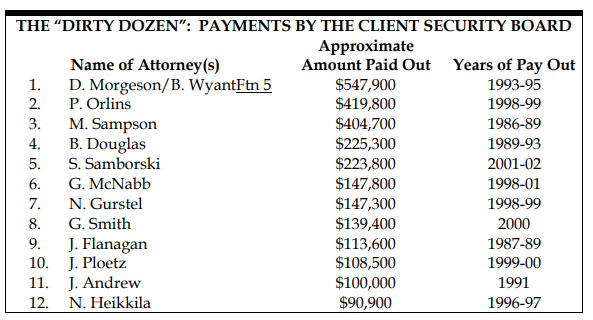
Note that Flanagan, who started it all, is “only” number nine on the list. Note also that six of the top ten listed have left the Board holding the bag since 1998, arguably a sign that even with the threat of disbarment and the increased threat of criminal prosecution, some lawyers are willing to risk everything for the almighty dollar (their clients’ dollar at that). Consider also that no claims were paid with regards to the large sums stolen by James O’Hagan in the 1980s and David Moskal in the 1990s, since claimants in these matters were paid from other sources. Had these two lawyers been solo practitioners rather than members of successful law firms, the Client Security Fund would have taken huge hits and all of us would have been assessed more to cover the loss.
So what do these ex-attorneys have in common other than their race and gender and the aforementioned willingness to steal from clients? A willingness to be disbarred and go to prison seems apparent, since misappropriation almost always results in the loss of a law license and since both local and federal prosecutors have shown in recent years that they will aggressively prosecute lawyers who steal. As to the areas of law these ex-lawyers practiced, unlike Flanagan and Sampson who gave plaintiff personal injury lawyers a black eye in the 1980s, lawyers who left large claims in more recent years, engaged in transactional work for the most part, including estate administration (Orlins and Smith), real estate (McNabb and Ploetz) and even collection work (Gurstel). All had one thing in common; all had access to client funds.
CLIENT SECURITY BOARD
While the number and severity of the claims paid by the Client Security Board over the past 15 years could have been worse, the amount involved is still sobering. Over $4.12 million has been paid to aggrieved parties stemming from the actions of 93 lawyers over 15 years, averaging $275,000 per year and $12,200 per approved claim.Ftn 6 The 16 lawyer members of the Board, who have served over these same 15 years, have stood in strong contrast to the “Dirty Dozen.” They, along with the public members, have contributed their time and expertise in an attempt to help clients exploited by avaricious lawyers. We all owe the 22 members of the Board over the past decade and a half a debt of gratitude for their service. Hopefully the next 15 years will not bring with it exploitation of this nature. However, if it does, we can count on several consequences. More likely than not, the lawyer will lose his license and go to jail. Meanwhile, the members of the Client Security Board, acting as a last resort, will be working hard to find a remedy for exploited clients. In so doing, they will be serving the public and they will be serving the profession.
NOTES
1 As of May 1, 2002, the current members of the Client Security Board are Timothy J. Kuntz, Chair; Richard I. Diamond; Beverly K. McKinnell (public member); Judith A. Pinke (public member); Michael T. Rengel; John S. Watson; and Margaret J. Westin.
2 See, generally, Rules of the Minnesota Client Security Board, III. Rules Governing The Claim Process
(3.01-3.18).
3 Rules 3.02, Rules of the Minnesota Client Security Board.
4 See Martin A. Cole, “Client Security: Can We Do Even More?,” Bench & Bar, July 2001, p. 14.
5 Dennis J. Morgeson, Sr. and Bruce P. Wyant are grouped together, since claims paid were made based on the actions of both attorneys.
6 It should be noted that over $600,000 has been paid to the Fund through restitution payments “from or on behalf of the lawyers against whom claims have been paid.” See Cole, p. 14.